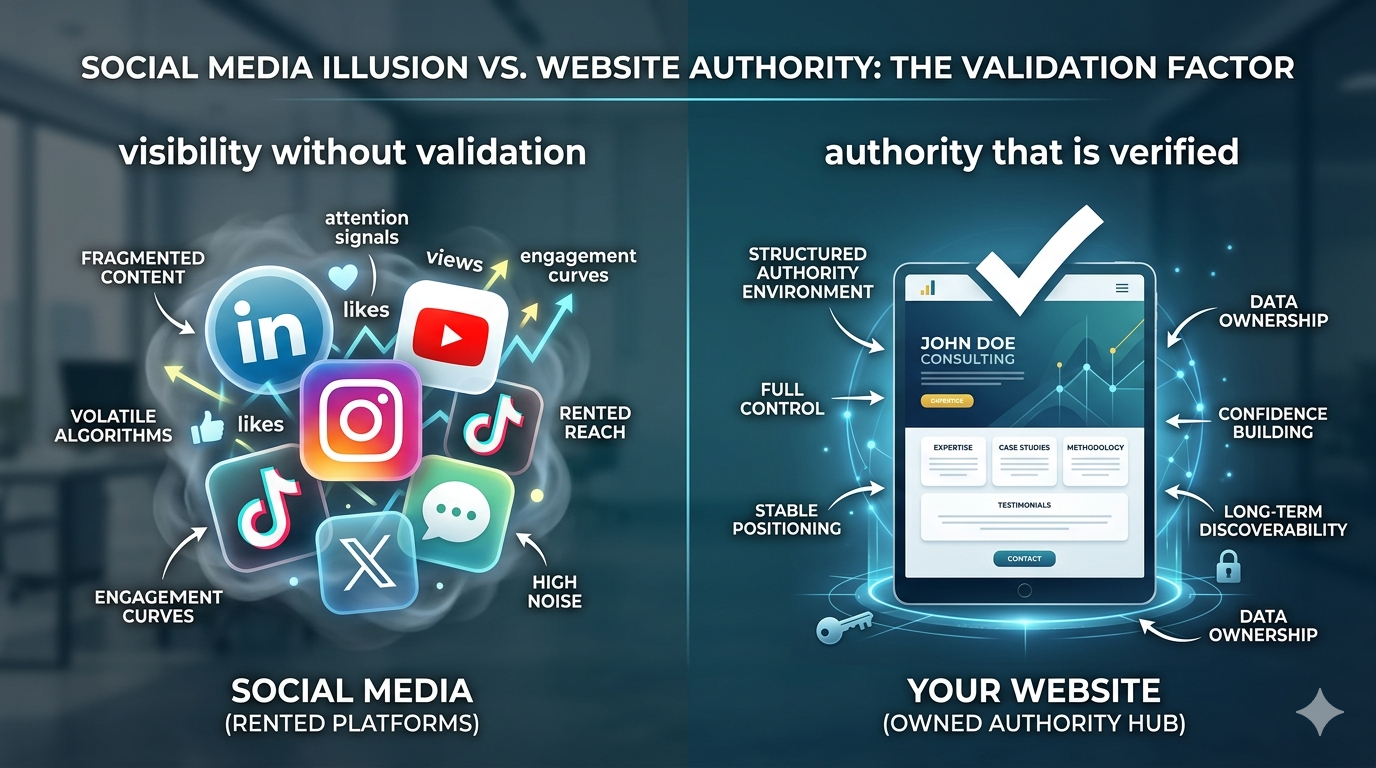
The Social Media Illusion
One of the most common statements heard from consultants, coaches, specialists, and small business owners is:
"I don't really need a website anymore."
The argument is usually based on visibility.
LinkedIn generates connections.
Instagram generates engagement.
YouTube generates views.
TikTok generates reach.
At first glance, the logic appears sound.
The problem is that visibility and authority are not the same thing.
Visibility introduces people to you.
Authority convinces them to trust you.
The distinction becomes increasingly important as markets become more competitive and attention becomes easier to obtain.
The Search Validation Moment
In hundreds of observations across professional service markets, one pattern consistently appears.
When people become interested in a professional, they investigate.
They search.
Not because they want more content.
Because they want confirmation.
Potential clients typically search for:
- Your name
- Your company
- Your expertise
- Your reputation
- Your credibility
This is the validation phase.
Many professionals invest heavily in attracting attention.
Far fewer invest in supporting the validation process.
The result is an Authority Gap.
The prospect becomes interested but lacks sufficient confidence to proceed.
The Authority Gap
The Authority Gap is the distance between perceived expertise and verified expertise.
Social platforms are excellent for demonstrating activity.
They are less effective for establishing institutional trust.
A website acts as a structured authority environment.
It allows prospects to evaluate:
- Expertise
- Experience
- Case studies
- Methodology
- Industry focus
- Contact pathways
Without a central authority asset, validation becomes fragmented.
Fragmented validation creates friction.
Friction reduces inquiries.
Why Websites Continue to Matter
The discussion is often framed incorrectly.
The question is not:
"Do websites still work?"
The question is:
"What role does a website play within a modern authority ecosystem?"
The answer is simple.
A website is no longer a brochure.
It is infrastructure.
Just as professionals require:
- An email address
- A professional identity
- A communication channel
They also require a digital authority hub.
This role cannot be fully replaced by rented platforms.
The Ownership Advantage
Every social platform belongs to someone else.
Rules change.
Algorithms change.
Visibility changes.
Reach changes.
Your website remains one of the few digital assets you fully control.
This creates strategic advantages:
- Stable positioning
- Search visibility
- Brand consistency
- Data ownership
- Long-term discoverability
Professionals who build only on rented platforms inherit platform risk.
Professionals who build authority assets create resilience.
The Business Card Evolution
Years ago, business cards were considered essential.
Today, websites serve a similar function.
The difference is scale.
A business card reaches one person.
A website reaches thousands.
A business card introduces.
A website validates.
A business card starts a conversation.
A website often determines whether the conversation happens at all.
The Future Belongs to Authority Assets
The rise of AI, social media, creator platforms, and search evolution has not reduced the importance of websites.
It has increased the importance of authority infrastructure.
As information becomes abundant, trust becomes scarce.
Professionals who invest in authority assets position themselves differently from those who rely exclusively on attention assets.
Attention can be rented.
Authority must be built.
The professionals who understand this distinction will remain discoverable, credible, and competitive regardless of platform changes.
Final Observation
People do not search because they need more information.
They search because they need confidence.
A website remains one of the strongest confidence-building assets available to professionals today.
Not because it generates authority.
Because it allows authority to be verified.
READY_FOR_DIAGNOSIS?
The intelligence briefing for Why Experts Still Need Websites in an AI and Social Media World is now complete. You have the technical evidence and the strategic context.
Does the Authority Building gap exist in your system?
We analyze your site. You see exactly where your system stands on this topic, what growth gaps exist, and what impact they are having on your revenue — within minutes.

ADEM TAVUKCU
Lead System Architect at Originizen. Specialist in node-based decision engines and operational metabolism. Adem has over 15 years of experience in optimizing remote-first global organizations.

